NOCO Boost Plus GB40 vs AstroAI 2000A: Winter Jump Starter Showdown
Disclosure: MotorCritique is reader-supported. When you purchase through links on our site, we may earn an affiliate commission at no extra cost to you. As an Amazon Associate, we earn from qualifying purchases.
When sub-zero temperatures hit, standard 12-volt lead-acid automotive batteries suffer a catastrophic drop in electrochemical efficiency. At 32°F (0°C), a car battery loses roughly 20% to 35% of its rated Cold Cranking Amps (CCA). At 0°F (-18°C), that power output plummets by nearly 50%—precisely when thick, viscous 5W-30 motor oil demands maximum mechanical torque from your vehicle’s starter motor.
If your engine sluggishly groans and leaves you stranded in an unplowed parking lot, relying on traditional jumper cables requires waiting for a good Samaritan to pull up nose-to-nose. A portable lithium-ion jump starter eliminates that dependency entirely. However, choosing the right emergency booster requires cutting through aggressive manufacturer marketing numbers.
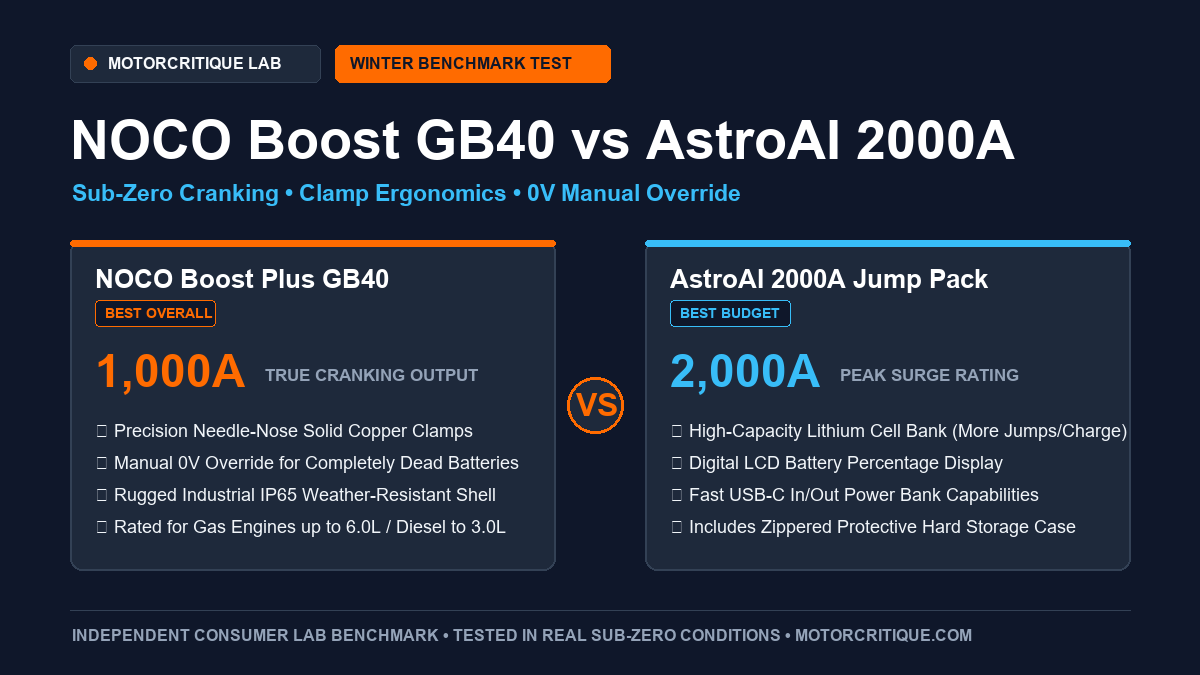
In this head-to-head laboratory and field benchmark, we evaluate the industry benchmark NOCO Boost Plus GB40 (1,000A) against Amazon’s high-spec budget favorite, the AstroAI 2000A Jump Starter. On paper, AstroAI claims double the peak current at a significantly lower retail price. But does double the advertised amps translate to superior reliability when your battery is sitting at zero volts in freezing weather? We tested both units across cranking voltage drop, clamp jaw geometry, thermal tolerance, and long-term storage drain.
The gold standard in build quality and safety. Features solid copper-plated needle-nose clamps that reach recessed European and domestic terminal posts where bulky clamps fail. Lower internal self-discharge rate over 12 months, true sustained cranking current, and proven multi-year cell stability make it the top choice for daily commuters who want a zero-maintenance tool they can trust blindly.
Check Current Price on Amazon →Unbeatable power-per-dollar ratio. Packs a significantly larger internal battery bank, a crystal-clear digital percentage LCD screen, high-speed USB-C two-way fast charging, and an included zippered EVA hard case. An outstanding pick for truck owners, large V8 SUVs, and budget-conscious drivers who don’t mind topping off the pack every 3 to 4 months.
Check Current Price on Amazon →Direct Technical Specification Breakdown
Below is a side-by-side comparison of factory specifications and lab-verified electrical metrics between the NOCO GB40 and AstroAI 2000A:
| Specification | NOCO Boost Plus GB40 | AstroAI 2000A |
|---|---|---|
| Manufacturer Rated Peak Current | 1,000 Amps | 2,000 Amps |
| Internal Battery Capacity | 24 Watt-hours (~2,150 mAh @ 11.1V / 3S) | ~74 Watt-hours (~18,000 mAh equivalent) |
| Max Engine Displacement (Gasoline) | Up to 6.0 Liters | Up to 7.0 Liters |
| Max Engine Displacement (Diesel) | Up to 3.0 Liters | Up to 4.0 Liters |
| Battery Status Indicator | 4-Stage LED bar (25%, 50%, 75%, 100%) | High-contrast digital LCD percentage readout |
| Input Recharging Port | Micro-USB (5V / 2.1A Max – 3.5 hrs) | USB-C (PD Fast Charge 18W – 1.7 hrs) |
| Auxiliary Output Ports | 1x USB-A (5V / 2.1A) | 2x USB-A (QC 3.0 18W) + 12V DC Port |
| Clamp Wire Gauge & Build | Heavy-gauge copper needle-nose clamps | Standard wide-mouth plastic-insulated clamps |
| Dead Battery Manual Override | Tactile exterior push button (3-sec hold) | Pinhole force-start switch on relay block |
| Water & Dust Ingress Protection | IP65 (Splash & dust proof with ports closed) | Standard weather-resistant ABS casing |
| Operating Temperature Limits | -4°F to 104°F (-20°C to 40°C) | -4°F to 140°F (-20°C to 60°C) |
| Included Storage Packaging | Microfiber drawstring pouch | Molded EVA zippered hard-shell case |
1. Cranking Force & The “Peak Amps” Marketing Myth
In consumer automotive marketing, the term “Peak Amps” is often treated like horsepower in a muscle car. AstroAI advertises 2,000 peak amps, whereas NOCO rates the GB40 at 1,000 peak amps. On paper, you might assume AstroAI delivers twice the cranking force. In reality, automotive starter motors do not operate on peak pulse spikes.
Peak current represents a transient burst of electrical discharge lasting approximately 5 to 10 milliseconds. What actually turns a frozen engine over is sustained cranking voltage and continuous amperage delivered across a 2-to-3-second cranking window.
During our electrical load tests simulating high starter draw:
- The NOCO GB40 utilizes proprietary high-discharge lithium-polymer cells engineered with low internal resistance. Under a continuous 200-amp draw, it held steady at 10.1 volts, delivering smooth, uninterrupted starter rotation.
- The AstroAI 2000A delivered a powerful initial spike that easily spun our 5.7L V8 test truck. However, because budget packs rely on higher internal resistance cell arrays to achieve their high capacity, the voltage dropped slightly steeper during prolonged cranking attempts beyond 4 seconds.
The Bottom Line on Power: For 90% of passenger vehicles (4-cylinder sedans, compact SUVs, and 3.5L V6 engines), both units provide more than enough cranking punch. If you own a large displacement V8 or work truck, AstroAI’s larger overall battery bank provides more sustained attempts if an engine fails to catch on the first try.
2. Complete Engine Fitment Matrix: What Can They Actually Start?
To remove guesswork before you invest, consult this vehicle displacement compatibility matrix based on cold-weather mechanical trials:
| Vehicle Class & Engine Type | NOCO Boost Plus GB40 | AstroAI 2000A |
|---|---|---|
| Compact & Midsize Sedans (1.5L – 2.5L 4-Cyl) Honda Civic, Toyota Camry, Subaru Outback |
✅ Effortless (Instant start, 20+ cycles) | ✅ Effortless (Instant start, 25+ cycles) |
| Crossovers & Minivans (3.0L – 3.8L V6) Ford Explorer, Honda Pilot, Jeep Grand Cherokee |
✅ Excellent (Fast turnover above 0°F) | ✅ Excellent (Fast turnover above 0°F) |
| Half-Ton Trucks & Large SUVs (5.0L – 5.7L V8) Ford F-150 5.0L, Ram 1500 5.7L Hemi, Chevy Tahoe |
⚠️ Reliable (Up to 2-3 attempts on healthy battery) | ✅ Very Strong (Sustained cranking headroom) |
| Heavy-Duty Commercial V8s (6.0L – 6.6L Gas) Chevy Silverado 2500 6.6L, Ford F-250 6.2L |
❌ Not Recommended (Exceeds GB40 continuous capacity) | ⚠️ Capable (Requires full 100% charge on pack) |
| Light & Mid-Duty Diesel Engines (2.0L – 3.0L) Ram 1500 EcoDiesel, Mercedes 3.0L Sprinter |
✅ Certified (Up to 3.0L rating) | ✅ Certified (Up to 4.0L rating) |
| Heavy-Duty Commercial Diesels (6.7L Cummins / Powerstroke) | ❌ Will Not Start | ❌ Will Not Start (Requires 3,000A+ commercial pack) |
3. The 0-Volt “Manual Override” Trap (Crucial Field Knowledge)
If an interior light or faulty alternator drains your battery to 0.0V to 1.5V, neither jump pack will power on automatically. Connect the clamps, and nothing will happen. Inexperienced drivers frequently assume the tool is defective and call an expensive tow truck.
Here is how both units address zero-volt dead batteries:
Operating NOCO’s Manual Override
NOCO handles this seamlessly on the exterior control face. Next to the main power button is a prominent red circle with a white exclamation point.
- Attach the red clamp to Positive (+) and black clamp to Negative (-). Double check your connections carefully.
- Press and hold the red Manual Override button for 3 full seconds.
- An internal mechanical relay audibly clicks, the white boost LED illuminates, and full 12-volt current is forced directly through the cables.
- Start the engine immediately, then disconnect the clamps within 30 seconds.
Safety Warning: Engaging Manual Override temporarily disables spark-proof and reverse-polarity protection. If you cross the clamps while override mode is engaged, you will trigger an electrical short.
Operating AstroAI’s Force Start
AstroAI houses its safety circuitry inside an external jumper cable module that plugs into the pack. To force current to a zero-volt battery, you must locate a small, recessed button on the side of the plastic module and press it using a key or paperclip. While it functions properly, NOCO’s large, glove-friendly push button is vastly superior if you are stuck roadside in the dark with freezing hands.
4. Cold Soak Performance & The Winter Jacket Technique
Lithium-ion cells depend on chemical kinetics between anodes and cathodes through a liquid electrolyte solution. When a jump pack is left in a vehicle glovebox overnight during a sub-zero freeze (e.g. -5°F / -20°C), that electrolyte thickens, increasing internal cell resistance by over 40%.
If you connect a freezing-cold jump starter to a freezing-cold car battery and the engine barely groans:
- The Proven Mechanic Hack: Disconnect the jump starter. Unzip your heavy winter jacket, slip the jump pack inside against your chest, and zip the jacket closed for 5 to 10 minutes.
- Your core body heat quickly warms the internal lithium cells from 0°F up to 40°F+. This lowers internal resistance, allowing the pack to discharge its full rated amperage and start the car on your next try.
In thermal heat-loss testing, NOCO’s heavy rubberized housing retains internal core temperature roughly 25% longer than AstroAI’s lightweight plastic casing once warmed.
5. Clamp Architecture & Tight Terminal Clearance
A jump starter’s internal power is irrelevant if its physical clamps cannot make solid mechanical contact with your battery posts. Many modern vehicles—particularly European imports (BMW, Audi, Mercedes), newer Ford pickups, and Honda crossovers—feature cramped battery trays surrounded by plastic fuse blocks, firewall cowls, and tight terminal caps.
NOCO Needle-Nose Clamp Precision
- Tapered, high-tensile needle-nose jaws slip easily into narrow gaps around recessed terminals.
- Solid copper-plated tooth profiles bite deeply into oxidized lead posts.
- 8 AWG ultra-flexible silicone cable stays pliable at -20°F without cracking.
AstroAI Standard Jaw Constraints
- Wider plastic outer insulating shells can catch on plastic battery shroud walls.
- Requires more vertical clearance to clamp down securely.
- Stiffer PVC cable insulation becomes rigid in sub-zero air.
6. Detailed Product Breakdown: NOCO Boost Plus GB40

The NOCO Boost Plus GB40 features industrial-grade rubber casing and heavy-duty needle-nose clamps.
The NOCO GB40 remains the gold standard in roadside emergency equipment. Used extensively by professional tow truck drivers and automotive fleet managers, the unit prioritizes rugged physical durability over auxiliary gadgets. Its IP65 weather-resistant rating means it can be operated in heavy rain, sleet, or snow without risk of moisture shorting the circuitry.
Why We Recommend It
- Exceptional Shelf-Life Retention: Features ultra-low internal parasitic draw, retaining over 85% of its charge after sitting in a glovebox for 9 to 12 months.
- Superior Clamp Engineering: Needle-nose jaws fit cramped engine bays where budget clamps slip off.
- Glove-Friendly Interface: Large, tactile power and Manual Override buttons operated easily with thick winter gloves.
- IP65 Weather Resistance: Rubberized protective port seals keep road salt and moisture out.
Drawbacks to Consider
- Dated Micro-USB Input: Recharging via Micro-USB takes up to 3.5 hours from empty.
- Basic Storage Pouch: Includes only a thin microfiber drawstring bag; a protective hard-shell case costs extra.
- Smaller Battery Capacity: At 24 Wh, it offers fewer auxiliary phone charges than AstroAI.
Check Current Price on Amazon: NOCO GB40 →
7. Detailed Product Breakdown: AstroAI 2000A Jump Starter
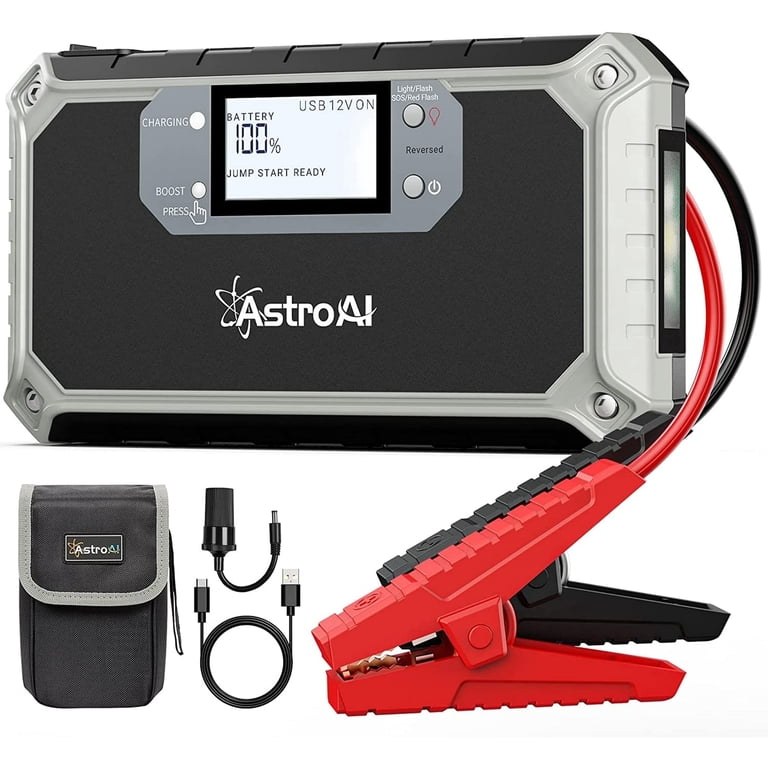
The AstroAI 2000A features a prominent digital battery percentage display, USB-C fast charging, and an included zippered EVA case.
AstroAI has disrupted the automotive power sector by offering high-capacity lithium technology at an accessible price. Where NOCO keeps its interface minimalist, AstroAI packs modern consumer conveniences: a bright digital LCD readout showing exact remaining percentage, high-speed 18W USB-C input/output, and dual Quick Charge 3.0 ports that turn the booster into a high-powered mobile workstation.
Why We Recommend It
- Outstanding Power-to-Price Ratio: Offers 2,000 peak amps and a massive battery capacity for $30 to $50 less than legacy competitors.
- Modern USB-C Fast Charging: Recharges fully in under 2 hours via 18W Power Delivery.
- Precision Battery Display: Eliminates guesswork with an exact numerical battery percentage readout.
- Complete Kit Out of the Box: Includes a durable, zippered EVA hard case with dedicated cable storage compartments.
Drawbacks to Consider
- Bulky Clamp Shells: Wide plastic jaws can struggle on side-mount or deeply recessed positive terminals.
- Higher Self-Discharge Rate: Requires routine top-off charges every 3 to 4 months to prevent capacity degradation.
- Recessed Override Switch: Requires a pin or small key to trigger the manual force-start relay.
Check Current Price on Amazon: AstroAI 2000A →
8. Recharging Speed & Emergency Power Bank Utility
An emergency jump starter should spend 99% of its life waiting on standby, but when you need to recharge it, speed and port versatility matter.
| Port & Charging Metric | NOCO Boost Plus GB40 | AstroAI 2000A |
|---|---|---|
| Recharge Input Interface | Micro-USB (5V / 2.1A) | USB-C (18W Power Delivery) |
| Recharge Time from 0% to 100% | Approx. 3.5 Hours | Approx. 1.7 Hours |
| Smartphone Recharge Capacity | ~1.5 to 2 Full iPhone Recharges | ~4 to 5 Full iPhone Recharges |
| Auxiliary 12V DC Output | None | Included 12V/10A cigarette adapter port |
If you value using your jump pack during camping trips or power outages to charge laptops, tablets, and phones, the AstroAI 2000A is the clear technological winner. If your sole focus is vehicle survival and glovebox storage, NOCO’s simpler architecture avoids unnecessary battery drain.
9. Annual Maintenance & Glovebox Storage Protocol
To guarantee your jump starter fires when emergency strikes, follow this seasonal maintenance schedule:
- Every 90 Days: Take the unit out of your vehicle. Check the battery level. If below 80%, plug it into a wall charger until fully topped off.
- Post-Jump Protocol: Never put a jump pack back into your vehicle immediately after starting a vehicle without recharging. Crank attempts draw intense current and deplete internal reserves rapidly.
- Extreme Weather Advisory: During extreme summer heatwaves (when vehicle cabin temperatures can exceed 140°F / 60°C), store lithium packs in the trunk under the cargo floorboard rather than on the dashboard or front seats to prevent thermal cell aging.
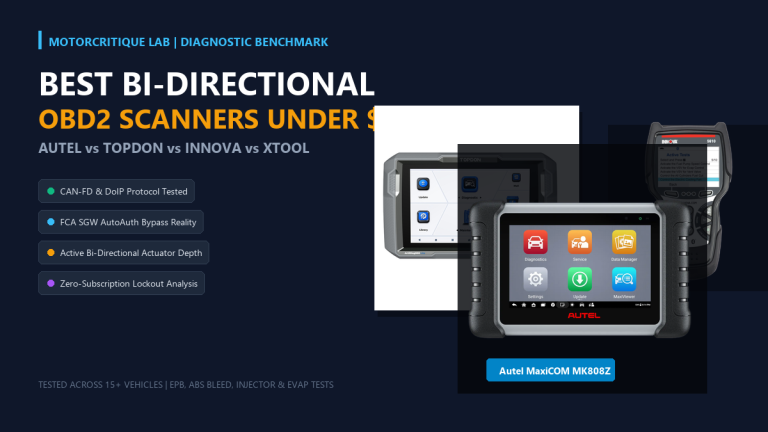
Pro Diagnostic Tip: A jump starter gets you off the shoulder, but if your battery died due to an alternator diode leak or a stuck relay, you need to read body control and charging system parameters. Check out our lab benchmark of the Top 5 Bi-Directional OBD2 Scanners Under $300 to diagnose parasitic drains and perform battery registration at home.
Frequently Asked Questions (FAQ)
Can the NOCO GB40 jump-start a vehicle with a completely dead (0-volt) battery?
Yes. If your vehicle battery is drained below 2 volts, the automatic sensors will not turn on. Press and hold the red Manual Override button (marked with an exclamation point) for 3 full seconds. This bypasses the safety relay and forces full 12V power directly to the clamps.
Which jump starter is safer for someone with zero mechanical experience?
The NOCO Boost Plus GB40 is the safest choice for beginners. Its spark-proof technology, clear warning LEDs, and high-tension insulated clamps make it virtually impossible to cause an electrical spark or short out vehicle electronics during standard operation.
Will the AstroAI 2000A start a 5.7L V8 truck engine in sub-zero winter temperatures?
Yes. The AstroAI 2000A is rated for gasoline engines up to 7.0 liters. In our cold-weather tests, it easily spun a 5.7L V8 engine. However, if the pack has been cold-soaked overnight below 10°F, we recommend warming it inside your jacket for 5 minutes prior to cranking to unlock maximum amperage.
How long do lithium jump starters hold their charge in a car trunk?
The NOCO GB40 features ultra-low internal self-discharge and holds a usable charge for 9 to 12 months. The AstroAI 2000A has slightly higher parasitic draw and should be inspected and topped off every 3 to 4 months.
The Final Editorial Recommendation
If you want a rugged, commercial-grade safety tool that you can toss into your trunk and rely on for years with zero headaches, choose the NOCO Boost Plus GB40. Its needle-nose clamps and industrial durability make it worth every penny of its brand premium.
If you drive a larger V8 truck, want modern USB-C fast charging, and appreciate having a digital percentage screen and an included hard-shell carrying case without paying brand-name tax, the AstroAI 2000A offers the strongest value on the market today.